
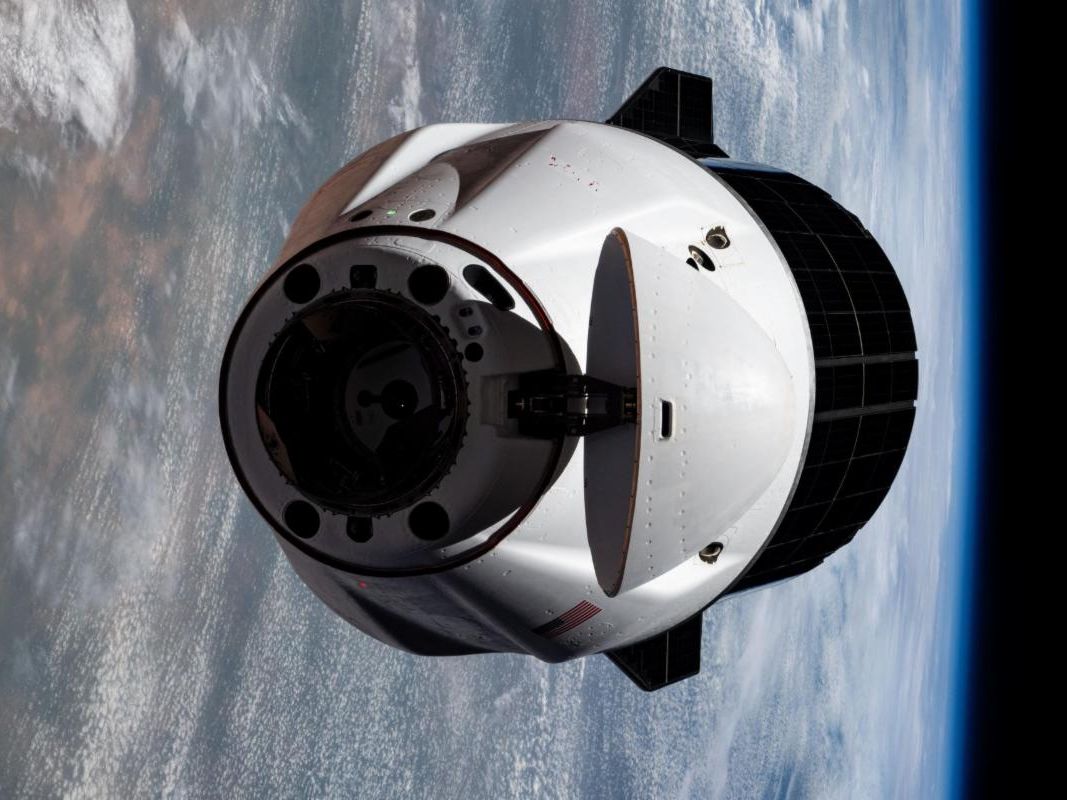
A SpaceX Dragon cargo spacecraft supporting NASA’s SpaceX CRS-33 mission approaches the International Space Station on Aug. 25, 2025, for an automated docking to the Harmony module’s forward port. Credit: NASA
Launch of SSEP Mission 20 and Mission 21 to the International Space Station
From Dr. Jeff Goldstein
Student Spaceflight Experiments Program (SSEP) National Program Director
Center Director, National Center for Earth and Space Science Education
The SSEP Mission 20 and Mission 21 to ISS flight experiments payloads, designated Atlantis and Discovery, respectively, are scheduled to launch Tuesday, October 13, 2026, at 6:33 am ET from Space Launch Complex 40 (SLC-40) at Cape Canaveral Space Force Station, Florida, aboard SpaceX CRS-35 (SpaceX Commercial Resupply Services 35). The SSEP Mission 20 payload consists of 4 experiments and the SSEP Mission 21 payloads consists of 17 experiments.
A heartfelt congratulations to the 3,821 students that participated in microgravity experiment design for these missions, and submitted 482 flight experiment proposals for formal review and selection; the 18,958 students that participated in the Mission Patch art and design competitions; and the 82 student Principal Investigators, Investigators, and Collaborators comprising the student researcher teams for the selected flight experiments from SSEP Mission 20 and SSEP Mission 21.
We are all exceedingly proud of you. You are the next generation of researchers, and today you stand on the frontiers of exploration.
Prior to launch, I would like to address SSEP students, and their instructors, administrators, and families. I want to provide a sense of their remarkable accomplishment – and not just the flight teams but the combined 22,000+ students engaged in microgravity experiment design and mission patch design competitions – and let them know they are truly part of America’s Space Program. I want to speak not just from the vantage point of the creator and director of SSEP, but also from the vantage point of 11 year old me watching the launch of Apollo 11 in July of 1969 and knowing in that moment I wanted to be a space explorer. There are these moments in our lives that change us, if we allow ourselves to be open to the experience. Maybe the launch of SpaceX-35, with your community’s experiment and mission patches aboard, can be one of those moments for many SSEP students. That’s why we created this program.
The launch will be covered live on NASA TV, and we’ve provided a video portal below if you’d like to watch right here on the SSEP National Program website. Also below is the original NASA Media Advisory M26-078.
I would also invite you to explore the SSEP Launch and On-Orbit Operations History page, which provides a sense of the rich history of the SSEP Program. Here you will find a list of SSEP missions and payload designations, videos of all SSEP launches, a list of all astronauts that have operated SSEP experiments, and videos of astronauts operating the experiments.
-Jeff
Schedule of Events
Tuesday, October 13, 2026
6:15 am ET – NASA coverage of the launch of SpaceX-35 begins (on NASA+, YouTube)
6; 33 am ET – Launch
Thursday, October 15, 2026
9:15 am ET – NASA coverage of the rendezvous and docking of Dragon at the International Space Station (on NASA+, YouTube)
Mission 20 to ISS Historical Data
Number of Participating Communities: 4
Scope: 441 grade 13-16 students engaged in microgravity experiment design
Number of student team proposals received: 41
Number of experiments selected for flight: 4; 4 communities flying 1 experiment
Announcement of Opportunity: September 13, 2024
Experiment design competition and proposal writing: January 6 – March 10, 2025 (9 Weeks)
Flight experiment selection: April 11, 2025
SSEP Mission 20 Details
– webpages
Mission 20 Media Coverage: 11 articles as of 9/3/26
Mission 20 Community Profiles: 4 communities, 11 organizational partners, 23 schools
– Media Package downloadable documents (PDFs)
SSEP National Program Overview
Mission 20 Flight Experiments Summary Table
Mission 20 Flight Experiments: Research Teams and Experiment Descriptions – an experiment-by-experiment summary including community, school, grade level, research team (PIs, Co-Is and Collaborators), and experiment abstract
Mission 21 to ISS Historical Data
Number of Participating Communities: 17
Scope: 3,663 grade 5-16 students engaged in microgravity experiment design
Number of student team proposals received: 441
Number of experiments selected for flight: 17; 17 communities flying 1 experiment
Announcement of Opportunity: May 14, 2025
Experiment design competition and proposal writing: September 2 – November 4, 2025 (9 Weeks)
Flight experiment selection: December 19, 2025
SSEP Mission 21 Details
– webpages
Mission 21 Media Coverage: 19 articles as of 10/9/26
Mission 21 Community Profiles: 17 communities, 55 organizational partners, 191 schools
– Media Package downloadable documents (PDFs)
SSEP National Program Overview
Mission 21 Flight Experiments Summary Table
Mission 21 Flight Experiments: Research Teams and Experiment Descriptions – an experiment-by-experiment summary including community, school, grade level, research team (PIs, Co-Is and Collaborators), and experiment abstract
WATCH SPACEX LAUNCH LIVE ON THIS NASA TV PORTAL
ORIGINAL MEDIA ADVISORY M26-078
NASA and SpaceX are targeting 6:33 a.m. EDT, Tuesday, Oct. 13, for the next launch to deliver science investigations, supplies, and equipment, including the final set of International Space Station Roll-Out Solar Arrays, to the space station. This is the 35th SpaceX commercial resupply services mission to the orbital complex for NASA.
NASA also will host a media teleconference on Thursday, Oct. 8 that will preview the cargo resupply flight, as well as provide a post-splashdown update for the agency’s SpaceX Crew-12 mission, which will have returned to Earth from the space station Thursday morning.
Loaded with more than 6,300 pounds of supplies, a SpaceX Dragon spacecraft on a Falcon 9 rocket will lift off from Space Launch Complex 40 at Cape Canaveral Space Force Station in Florida. Dragon will dock autonomously around 11 a.m. on Thursday, Oct. 15, to the space-facing port of the station’s Harmony module.
NASA’s live launch and docking coverage will stream through a variety of platforms. Learn where to watch online:
https://www.nasa.gov/live
In addition to the solar arrays, the Dragon spacecraft will deliver hardware to manufacture artificial retinas in microgravity to help restore vision on Earth and 3D heart tissues models to advance large‑scale drug testing on future missions. The spacecraft will carry materials to study how a new type of glass forms in microgravity and brain organoids that could reveal treatment targets for neurodegenerative diseases, such as Alzheimer’s, Parkinson’s, and multiple sclerosis.
The Dragon spacecraft is scheduled to remain at the space station until mid-November when it will depart the orbiting laboratory and return to Earth with time-critical research and cargo, splashing down off the coast of California.
NASA’s mission coverage is as follows (all times Eastern and subject to change based on real-time operations):
Thursday, Oct. 8
1:15 p.m.: International Space Station briefing for Crew-12 return, and SpaceX’s 35th Commercial Resupply Services launch with the following participants:
Bill Spetch, deputy manager of Commercial, Low Earth Orbit Program
Dr. Liz Warren, deputy chief scientist, NASA’s International Space Station Office
Lee Echerd, senior mission manager, Customer Operations and Integration, SpaceX
Andreas Mogensen, leader, Human Exploration Group, ESA (European Space Agency)
To participate in the teleconference, media must contact the NASA Johnson Space Center newsroom for call details by 12 p.m., Oct. 8, at: jsccommu@mail.nasa.gov or 281-483-5111. To ask questions, media must dial in no later than 10 minutes before the start of the call. The agency’s media credentialing policy is available online.
Tuesday, Oct. 13
6:15 a.m.: Launch coverage begins
6:33 a.m.: Launch
Thursday, Oct. 15
9:15 a.m.: Arrival coverage begins
11 a.m.: Docking
NASA website launch coverage
Launch day coverage of the mission will be available on the NASA website. Coverage will include live streaming and blog updates beginning no earlier than 6 a.m. on Oct. 13, as the countdown milestones occur. On-demand streaming video on NASA+ and photos of the launch will be available shortly after liftoff. For questions about countdown coverage, contact the NASA Kennedy Space Center newsroom at 321-867-2468. Follow countdown coverage on our International Space Station blog for updates.
Attend launch virtually
Members of the public can register to attend this launch virtually. NASA’s virtual guest program for this mission also includes curated launch resources, notifications about related opportunities or changes, and a stamp for the NASA virtual guest passport following launch.
Watch, engage on social media
Let people know you’re watching the mission on X, Facebook, and Instagram by following and tagging these accounts:
X: @NASA, @NASASpaceOps, @NASAKennedy, @Space_Station, @ISS_CASIS
Facebook: NASA, NASAKennedy, ISS, ISS National Lab
Instagram: @NASA, @NASAKennedy, @ISS, @ISSNationalLab
Learn more about International Space Station operations and research at:
https://www.nasa.gov/station
-end-
About SSEP Mission 20 to ISS
The Student Spaceflight Experiments Program [or SSEP] is a program of the National Center for Earth and Space Science Education (NCESSE), in the U.S. and the Arthur C. Clarke Institute for Space Education internationally. It is enabled through a strategic partnership with Nanoracks / Voyager, which is working with NASA under a Space Act Agreement as part of the utilization of the International Space Station as a National Laboratory.
About SSEP Mission 21 to ISS
The Student Spaceflight Experiments Program [or SSEP] is a program of the National Center for Earth and Space Science Education (NCESSE) in the U.S. and the Arthur C. Clarke Institute for Space Education internationally. It is enabled through a strategic collaboration with Rhodium Scientific, America’s first space biotech and ISS Commercial Service Provider, working with NASA through a CASIS Agreement to utilize its facilities aboard the International Space Station for this mission.
The International Space Station (ISS) National Laboratory is a National Partner of the Student Spaceflight Experiments Program.
SSEP is the first pre-college STEM education program that is both a U.S. national initiative and implemented as an on-orbit commercial space endeavor.




No comments yet.